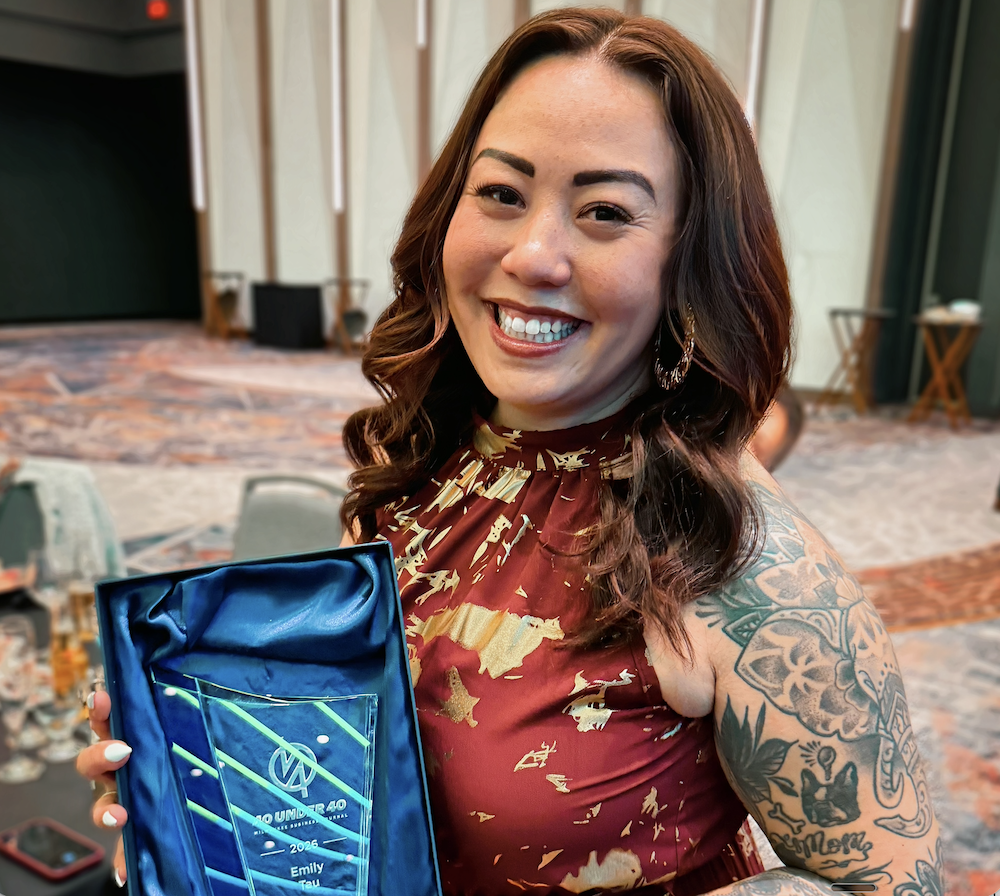
Emily Tau didn’t set out to build a career in government communications. Her path started in hospitality, moved through agency work and tourism marketing, and shifted dramatically during the COVID-19 pandemic, when she was recruited to lead communications for the Milwaukee Health Department.
Today, as Director of Public Affairs for Milwaukee County, Tau helps shape messaging and strategy for County Executive David Crowley while translating complex public issues into clear, community-centered communication. Her work spans press conferences, public policy, crisis response, stakeholder relationships and storytelling rooted in trust.
In this Q&A, she reflects on what public service has taught her about empathy, accuracy, resilience and the power of taking a nontraditional path.
Tell us who you are, where you're from, and how you'd describe yourself to someone who's never met you.
My name is Emily Tau. I grew up in the northwest suburbs of Chicago, but Milwaukee has been home for me since I came to Marquette University for college.
I describe myself as a connector at heart. I care deeply about people and about building communities where everyone feels seen, supported, and valued. Those values show up in a lot of different ways for me: through my work in public service, my commitment to advancing public health initiatives, my dedication to mental health advocacy, and my passion for the arts and using storytelling to understand the world and one another better.
When I’m not in work mode, I love to travel as much as I can or just relax with a book at my favorite coffee shop, wine bar, or park.
You've been Director of Public Affairs for Milwaukee County for nearly three years now. For readers who don't know the role, how do you describe what you actually do day to day, and what surprises people most when you tell them?
Public Affairs encompasses work in communications, community engagement, and public policy, which is why I often joke that my job description simply says “other duties as assigned.”
No two days look the same for me. You can find me at a community event with a camera in hand, back at my desk writing a speech or press release, or even editing video or designing graphics. My days are often spent representing Milwaukee County at community events, building partnerships with community leaders, and crafting external communication for our residents. I also plan and execute press conferences and large-scale events, including the annual State of the County address.
Your career path is unusual for government comms: hospitality, agency work, tourism marketing, public health, and now the County Exec's office. What pulled you from the private sector into public service, and was there a specific moment it clicked?
I never actively sought out work in public service, but it quickly became something I fell in love with. I was working in tourism when the COVID-19 pandemic hit, which put a heavy strain on the economic impact of the travel and hospitality industry. About a year into the pandemic, the Mayor’s office reached out to recruit me to serve as the Communications Director for the Milwaukee Health Department.
I also never expected to work in public health, but that role fundamentally changed the direction of my life. It was one of the most emotionally challenging and intellectually demanding moments of my career, but it gave me the language and focus for issues I'd long been passionate about but hadn't known how to articulate or where to direct my energy. I now view every societal issue we face through a public health lens, which helps me understand the compounding systemic forces underlying all the challenges we face today.
You serve as counsel to County Executive David Crowley on messaging and strategy. What's the hardest part and best part about shaping communications for an elected official?
The hardest part of the job is developing a deep understanding of the context behind every issue. Milwaukee County oversees an enormous range of services, from housing development and harm reduction to public transportation and emergency response. These are complex topics with initiatives often years in the making, and the communications coming from an elected official need to be mindful of the nuance, history, and political implications of their words.
Before Milwaukee County, you led communications for the largest public health department in Wisconsin. What did that role teach you about crisis communication and public trust that you still use today?
I think about the Theodore Roosevelt quote, “Nobody cares how much you know until they know how much you care.” During times when emotions are running high and fear and anxiety are driving behaviors, people simply want to be heard and feel protected. You can’t know what message the community needs to hear or build public trust if you’re not listening first.
I also learned a lot about moving quickly and accurately. During a crisis, information is constantly being updated, so you have to communicate frequently. But once a message is out, you can't take it back. Even if you issue a correction, the incorrect information has already been shared. That doesn't just create confusion for residents who need accurate guidance; it erodes public trust in ways that are hard to rebuild. The ability to move fast without sacrificing accuracy is one of the most critical skills in crisis communications.
Approvals, legal review, political sensitivity: How have you learned to move fast inside a system that's designed to move carefully?
Learning to lean on your team is essential. Communications moves incredibly quickly, and it’s impossible to be an expert in every law, political impact, or subject. However, governing bodies are full of subject matter experts who are working every day in their fields. Knowing who to go to for guidance, information, and expertise is invaluable.
You completed the PRSA Measurement and Analytics Program and built metrics work into your VISIT Milwaukee role. How do you measure success in a public sector job, where the goals aren't always leads, revenue, or conversions?
In the public sector, we’re not trying to grow an audience or reach new consumers. We’re communicating crucial information that the public needs. Those messages flow through our local media outlets, which means metrics like impressions or ad value are essentially meaningless; the reach is largely fixed by our population data. What actually matters is whether the message is actually reaching and resonating with the community.
During my time at the Milwaukee Health Department, for example, a major focus was on providing education about the COVID-19 vaccine, encouraging vaccination, and promoting clinics and events across the city. The real measure of success wasn’t how much media coverage we received. It was whether vaccination rates were climbing, particularly among the demographics we were intentionally trying to reach, and whether people were actually showing up to clinics.
So much of your work involves building and maintaining relationships with community leaders, advocacy groups, and other officials. What's your approach to stakeholder relationships, and how is it different from managing client relationships at an agency?
One of my favorite things about Milwaukee is the cross-sector collaborative nature of our community. My approach to stakeholder relationships is the same as my approach to any relationship. We are all human, first and foremost, and connecting with empathy, humility, and authenticity is the only way to truly build a relationship and partnership. When I take the time to understand people, their motivations, and the why behind their work, conversations become more productive and collaborative. More often than not, we’re working toward the same goal, and grounding our work in shared connection is what makes progress possible.
Milwaukee shows up in your bio, your career and your identity. What does it mean to you to do this work specifically in this city, and how does knowing Milwaukee shape the way you communicate on its behalf?
You’d never know I’m not a Milwaukee native based on the way I talk about this city! I never planned to move to Milwaukee or stay here as long as I have (Somehow, it’ll be 20 years this year!), but I fell in love with so much about this community. The people are genuine; there’s no pretension or arrogance. We have Lake Michigan in our backyard and over 150 acres of accessible, public green spaces. We have incredible restaurants, a thriving creative arts scene, and unique events year-round.
And, Milwaukee is not without its challenges. Historic redlining, continued disinvestment in communities of color, and other policies rooted in racism have left generational effects on our residents. And, like an urban area, we’re grappling with gun violence, reckless driving, and the opioid epidemic.
So, when I communicate on behalf of Milwaukee, I want to remind people that multiple things can be true at the same time. Milwaukee is an incredibly welcoming city and one that is heavily segregated. Milwaukee is investing in a revitalized downtown while still underinvesting in other neighborhoods. Milwaukee has a small-town feel and still has areas that feel unsafe to walk alone. We have culture and crime. We have progress and poverty.
Milwaukee is an amazing place to live, and there is still so much work to be done. And that dichotomy is what keeps me here.
What's a project, campaign, or moment from the last couple of years you're especially proud of and why that one?
A moment that stands out is the emergency response to the extreme storms and historic flooding that hit Southeastern Wisconsin in August 2025. With no communications director in the Milwaukee County Office of Emergency Management, I stepped in as the Public Information Officer in the Milwaukee County Emergency Operations Center.
I worked closely and collaboratively with emergency response partners at all levels of government – from municipal EMS, to the Wisconsin Emergency Management (WEM) division, to the U.S. Federal Emergency Management Agency (FEMA) – to ensure affected residents had access to the critical information they needed to recover. That meant hosting emergency press conferences, disseminating numerous press releases, and building out a multilingual resource hub online, with public health guidance and vital recovery resources. I spent hours reading FEMA guidance to ensure I had a thorough understanding of the process and could effectively respond to questions and address any confusion.
I’m proud of the work we accomplished because it resulted in over $152 million in federal assistance for more than 30,000 Milwaukee County residents and households to kickstart their road to recovery. But I’m also proud on a personal level. The feedback I received from our FEMA partners was incredibly affirming. Their external affairs director even expressed that this was “one of the smoothest disasters I can remember ever working on.” They requested copies of our resource website and graphics to use as models for other communities responding to disasters. And when FEMA distributed guidance following the April storms, the document they shared was built around a flowchart my team had created. That was a reminder that the work I’m doing truly does make an impact.
What would you tell a marketer or comms professional who's curious about public sector work?
Public service is definitely not for everyone. It takes patience, resilience, and a deep sense of responsibility to the people you serve. And, if I’m being honest, it can often feel like thankless work. You have to have thick skin and a soft heart.
But it’s also some of the most rewarding work you can do. If you’re someone who believes in helping their community, feels a responsibility to work toward something bigger than themselves, and wants to make a real impact on the lives of their neighbors, I encourage you to consider a career in the public sector. You’ll also be given the privilege of working alongside some of the most dedicated, empathetic, brilliant, and selfless people every single day.
What do you wish more people understood about how government communication actually works?
I wish more people understood how much government communicators are working to serve the public, not manage them. There's a perception that public sector communications is about spin – controlling the narrative and protecting the institution. But the work I do every day is fundamentally about making sure people have the information they need to access services, make decisions, and feel connected to the place they live.
In my experience, public servants working at the local level are genuinely trying to do the most good for their community that they can, with the limited resources they have. It’s our job as communicators to make sure the programs, services, and initiatives they're working hard on actually reach the people who need them.
The work is getting harder, but we are all doing our best. Trust in government is at an all-time low, and declining media and civic literacy mean that almost everything we put out is met with some form of hostility, trolling, or anger – much of it rooted in misunderstanding or misinformation. I believe deeply in holding people in power accountable, but reflexive distrust, often untethered from facts, doesn't serve anyone.
What are you most proud of in your career, either in your current role or overall?
I think the thing I’m most proud of is the relationships I’ve built. Not only have they shaped my career trajectory in ways I never anticipated, but they also give me the ability to connect people to one another. Because my experience has spanned various industries, I’m in the unique position to make connections that may not otherwise happen: an arts organization to a local bar for a fundraiser, or a public health nonprofit to a web developer to help amplify their presence.
I’m immensely proud that I’ve built a reputation as someone who always shows up to help.
Anything else to add?
As you already noted, my career path has been unusual. I graduated from Marquette in 2010, during the heart of the recession. Entering a job market with minimal opportunities meant that I spent the majority of my 20s working in bars and restaurants. At the time, it felt like I was ”wasting” my degree, but some of the most valuable professional skills I have came from jobs that didn’t look like obvious professional stepping stones. Bartending taught me customer service, conflict de-escalation, multitasking, how to perform under pressure, and other invaluable transferable skills.
So, my advice to anyone who feels like they’re “behind” is always this: Do not be afraid of taking a nontraditional path. There is no “right” way to live your life or build your career. When you give yourself permission to step outside of the arbitrary expectations of where you should be and redefine what success looks like for you, you’ll find the freedom to pursue work that aligns with who you are, not who you think you’re expected to become.