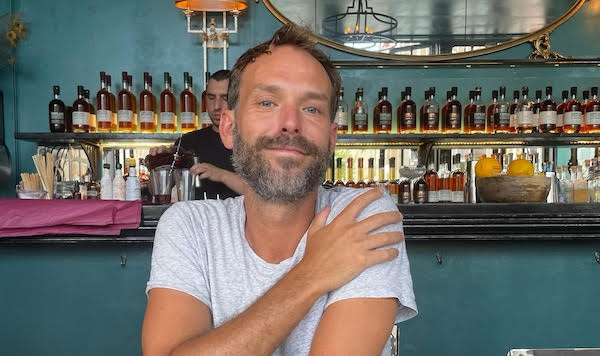
Noah Davis didn’t chase a career in media so much as he chased curiosity.
After college, he moved to New York, bused tables at night, and pitched by day—until eavesdropping as an intern led to a steady sports column and his first press pass.
Two decades later, Davis’s bylines span The New Yorker to The New York Times, with standouts on Bob Bradley, the economics of freelancing, and the science-policy tangle of GLP-1s.
He co-founded Three Point Four Media to bring reporter-grade storytelling to brands, building long-term wins for clients like Acumen America while advising early-stage teams at VHS Ventures.
In this Q+A, he shares his lessons on a clean “no” over a muddy “maybe,” keeping the creative flywheel spinning, and turning even harsh edits into better work.
What first drew you to journalism back in 2005, and what was your earliest “this might actually work” moment?
I don’t know if I was ever drawn to journalism per se. I think it’s more that I’m curious and shy; telling other peoples’ stories is a good use of these qualities. My senior year of college, I would tell people my plan was to “move to New York and be a writer,” so after graduation I moved to New York and got a job as a busboy. I pitched stories during the day and worked at the restaurant at night. It was great. I was lucky enough to have a couple wonderful mentors who helped build my confidence, my skills, and my bank account, some more quickly than others.
How did you land your first pieces with national outlets and what bylines made you most proud?
My first “big break” came when I was an intern at Time Out New York. I overheard two editors talking about how they needed a sports editor and I blurted out that I could do it. They looked at each other like who is this person and why is he eavesdropping, and then gave me a shot. For the next two years, I had a sixth of a page in every issue of the magazine writing about whatever the Knicks/Nets/Yankees/Mets/etc. were doing. I think I got $100 per column. But “Sports Editor, Time Out New York” sounded impressive and probably opened some doors. At the very least, I got a press pass to the 2006 US Open and saw Andre Agassi’s last career victory.
I think this piece captured former United States men’s national team coach Bob Bradley better than anything else written about him. A story for The Awl about the economics of freelancing helped drive the conversation about money and writing. (People in creative fields should talk about money!) More recently, this article about GLP-1s, addiction, and FDA trials turned out well.
You have interviewed interesting subjects throughout your career. What are a few that still stand out to you today?
For Esquire, I talked to chess superstar Magnus Carlsen on the phone while trying to hail a cab in a snowstorm at JFK airport. This was not a good interview, but it was memorable.
I did an interview series for Pacific Standard (RIP; RIP to so many of the publications I wrote for) where I chatted with the smartest person I could find. At the end of the interview, I would ask the subject who I should talk to next. At one point, I found myself having a long conversation with Stephen Wolfram, the billionaire founder of Wolfram Alpha and Mathematica. Just a very wild, weird, cool moment, like how did I end up here?
And, of course, some charming goof who committed himself to drinking a beer and running a mile every day.
What’s a rejection story that taught you something you still use?
As a freelancer, you hear no a lot. And that’s fine. (My business partner, Bill, and I always talk about how no is infinitely better than maybe.) You have to learn to separate the rejection from the quality of the idea. There are a million reasons why your story idea won’t work for an editor: bad timing, someone else is working on something similar, they are in a bad mood, they have no freelance budget, the freelance budget has to go to the owner’s best friends’ son, etc. As long as you are confident that your idea is good, you shouldn’t take no personally. As long as you hear yes sometimes, too, you’re fine.
With freelance writing work, you have to be prolific and keep producing work all the time. What was your process like to be most productive?
My best weeks or months or years were the times when I had a few steady gigs that I was doing on a regular basis but also enough time to think up, pitch, and execute larger/different/more ambitious projects. Keep the flywheel spinning. Focus on productivity rather than volume. If you’re not feeling creative, do some accounting or expensing or other mundane task.
Go to a movie in the middle of the afternoon occasionally.
When all else fails, run. Don’t listen to music or a podcast. Let yourself think. If you have a great idea you’re worried about forgetting, most bodegas will let you borrow a pen and piece of paper. Try to write legibly, despite your haste.
What’s a note, edit or advice from an editor or outlet that sticks with you today when you interview, sit down to write or edit?
Early in my career, I was writing for Goal.com. We had, for lack of a better word, an anonymous troll who frequently emailed us vicious critiques of articles we wrote. Nitpicky details, the kind of notes you see in an old movie about young writers being verbally abused by an ancient, ink-stained newspaper editor. (We eventually figured out who he was, and that’s exactly who he was.)
His emails were mean-spirited and obnoxious, and he was a jerk. But after a few months of being mad at him, I realized that he was also right about a lot of what we were getting wrong. He was, in his way, trying to make us better. I never understood why he cared so much about a site he didn’t have any stake in or the words of a handful of 20-something writers he was never going to meet. These were the writer vs. blogger days, and he was simply trying to impart some wisdom in the way he knew.
You’ve switched between staff roles, freelance, agency founder, editor and advisor. What was the hardest transition and why?
I wouldn’t say any of the transitions have been that difficult. Each new thing grew out of what came before. The couple of times I’ve been on staff happened because of the freelancing I had been doing. We started Three Point Four Media as an outgrowth of where we saw the media industry going, which was less about traditional outlets and more about storytelling in different capacities. Being an advisor at VHS Ventures comes from a combination of writing (I met the founder when I interviewed him for a story) and working with startups like we do at Three Point Four.
It’s all the same skills, just used in different ways.
You created Three Point Four Media in 2017. What was the inspiration and mission for your new venture?
Bill and I were both freelance writers, and decently successful, but an increasing portion of the work we were doing was writing for non-traditional outlets and custom content for brands. Almost all companies today need some sort of editorial or content or storytelling arm, and, increasingly, that work needs to be good. Customers and potential customers are too smart and savvy, and inundated with messaging and ads, to be fooled by garbage. We thought we could use the skills we developed as journalists—storytelling, reporting, writing, editing, thinking—as well as the network of freelance photographers, developers, videographers, and other creatives to build a business.
It’s been almost eight years, and we’re still here. We’ve worked with big companies like Google, Nike, and The North Face, as well as smaller, growing brands.
What do you look for when assembling teams or content creators for clients?
The most important thing is the right fit for a project. Sometimes, we’re leading that process and will suggest a person or two to the client, and sometimes the client says “we want a photographer who has shot fashion for GQ,” and then we’ll go out and find a couple people who fit that bill, bring them back to the client, and present them as options.
What’s a campaign or project you worked on that really demonstrated how editorial craft can move brand outcomes?
We’ve been working with Acumen America for a few years now, doing all sorts of different things for them: building a new website, writing features about companies they invest in, running their LinkedIn, programming their CEO summit, making videos, prepping their managing director for a panel with Serena Williams, and re-working their messaging. It’s a little bit of editorial, a little bit of marketing, a little bit of PR, and a lot of storytelling. For us, and for them, that model works. We’ve built a level of trust back and forth, and we can all work together to say what they want to say, how they want to say it. It’s been fun to watch them grow the size of their fund, and have played a small role in that success.
What’s the most instructive interview you’ve done in sports, either because it went better than expected or went sideways?
This profile of Brian Scalabrine changed how I think about athletes more than anything else I wrote. Big Scal was a fan favorite, mostly for being a big, doofy white guy who rode the end of the bench. And that’s not untrue. But also, Scal is, like, infinitely better at basketball than anyone you or I know. He said something like “every day at practice, I guard Paul Pierce. Do you think they’d keep me around if I didn’t make him work?” By that point, I had spent enough time in locker rooms, watching practices, and covering sports to realize how much better the “bad” professional athletes are than normal people, but something about that crystallized it for me.
For creatives who want to work with startups, what advice do you have?
Listen—actually listen—and be flexible. A startup is going to succeed because the founder and early employees are immersed in their business. This is great, but it’s also easy for them to lose sight of what matters to potential customers who aren’t so involved. Understanding that dynamic is essential.
If you taught a workshop based on your career so far, what’s the syllabus?
Moby Dick.
At a high level, I’m not sure what I would teach. I wouldn’t recommend anyone follow the career path I did; starting out as a freelance writer is not a sustainable pursuit in 2025. There are ways to make a career in media but not by following how I got to wherever I am.
I would talk a bit about Stratechery and After School. The insatiable curiosity of Joe and Tracy at Odd Lots, and their focus on facts seems important. I’m fascinated by, and in awe of, Kyle Chayka’s path as writer, thinker, and media entrepreneur. This is a bit of recency bias, but I loved Dan Wang’s Breakneck for its combination of observational reporting and historical perspective. I’ve always liked this speech Bill Watterson gave at Kenyon in 1990.
I’d ask everyone to share one person who helps them understand the world. Two if we finished Moby Dick quickly.
Anything else to add?
Say yes. Reply to emails. Follow up.