You created a Big Shoes Network job seeker account, uploaded your resume and checked the “available for work” box.
Now what?
One of the benefits of creating a free Big Shoes Network job seeker account is that employers searching for marketing, communications, public relations, digital, creative and related talent can discover your profile — even before you apply for one of their openings.
But simply creating an account doesn't guarantee that an employer will reach out.
Think of your Big Shoes Network profile as another tool in your career search. The easier you make it for employers to understand what you do, what you're good at and what kind of opportunity you're looking for, the more useful your profile can be.
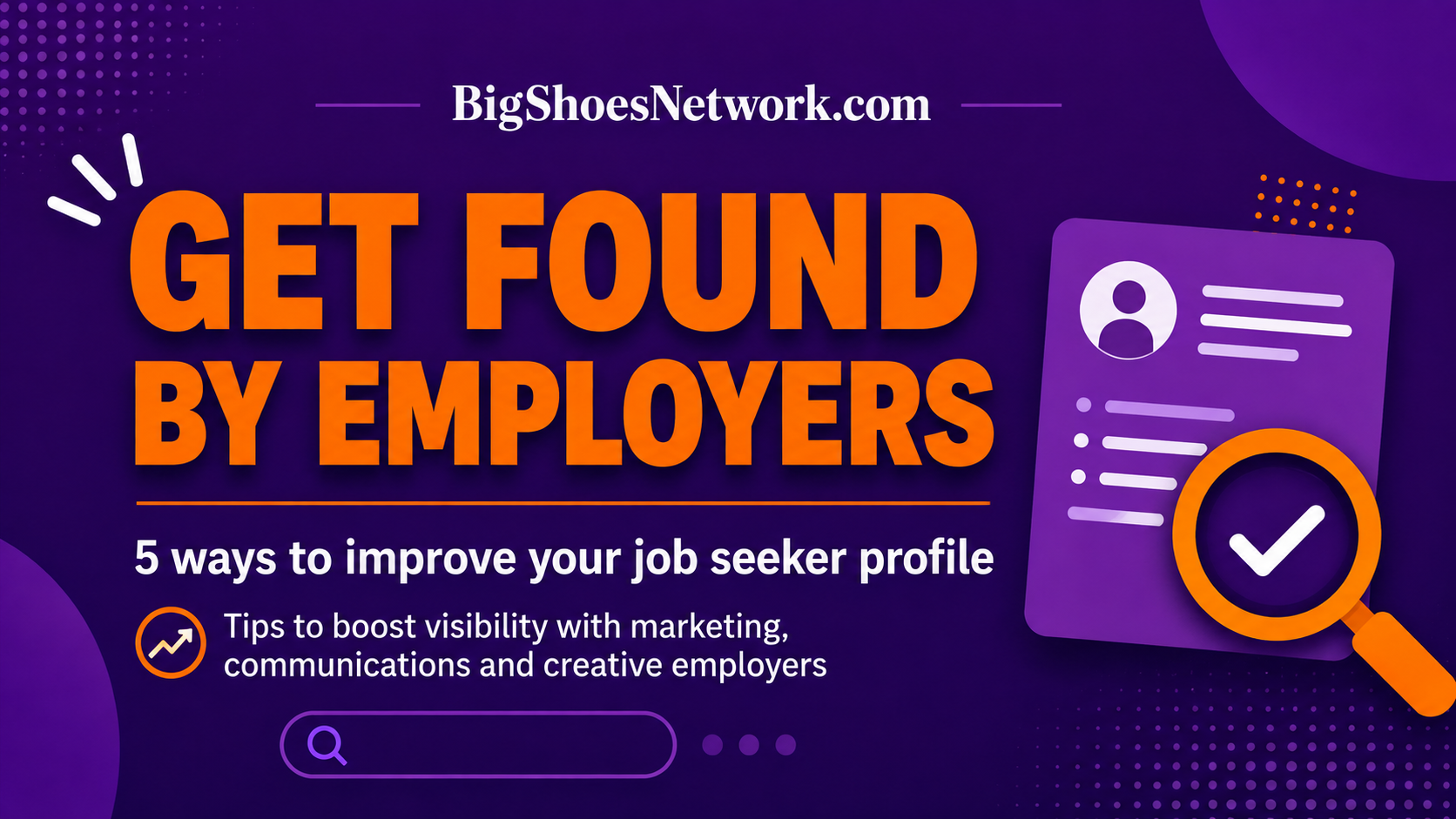
Here are five ways to improve your chances of getting noticed.
1. Make Sure You're Actually Marked “Available for Work”
Let's start with the easiest one.
When you create your Big Shoes Network job seeker account, you'll see an “Available for work” option. This setting matters: employers can view your profile and contact you only when your account is set to available.
If you've had an account for a while, this is worth double-checking.
Start here: Create or update your Big Shoes Network job seeker account
And while you're there, make sure the resume attached to your profile is still your current one. Promotions, new responsibilities, freelance projects, certifications and new skills can quickly make an older resume outdated.
2. Use the Words Employers Search For
A creative job title might sound great internally at your company, but will a recruiter know what it means?
If your official title is something like “Brand Storyteller III,” but the work you actually do is content strategy, copywriting, email marketing and social media management, make sure those terms appear prominently in your resume.
Employers frequently search candidate databases using combinations of job titles, skills, specialties and experience. Describe your experience using the language employers use.
Not sure which keywords matter? Look at five or 10 positions you'd seriously consider and note the phrases that keep appearing.
For marketing and communications professionals, those might include:
- Marketing strategy
- Corporate communications
- Public relations
- Media relations
- Content strategy
- Copywriting
- SEO
- Email marketing
- Marketing automation
- Social media
- Paid media
- Analytics
- CRM
- Brand strategy
- Internal communications
- Event marketing
- Graphic design
- Video production
- Business development
Then incorporate the terms that truthfully reflect your experience into your resume.
Indeed offers a useful overview of how resume keywords work, including why employers and recruiting systems use them to identify relevant candidates.
3. Be Specific About What You've Accomplished
There's a big difference between:
Managed email marketing campaigns.
and:
Managed a weekly email program reaching 35,000 subscribers, increasing average click-through rate by 28% over 12 months.
Both describe the same general responsibility. The second tells an employer what kind of impact you can make.
Whenever possible, look for ways to quantify your work:
Instead of:
Managed social media.
Try:
Led organic social strategy across LinkedIn, Instagram and Facebook, growing total audience by 40% in two years.
Instead of:
Responsible for website content.
Try:
Led content strategy and SEO improvements that increased organic website traffic by 32%.
Instead of:
Worked with company leadership on communications.
Try:
Advised senior leadership on executive communications, media strategy and internal messaging for a 1,000-employee organization.
Your resume shouldn't just be a list of things you were responsible for. It should help an employer quickly understand what changed because you were there.
For additional help, Big Shoes Network also maintains a directory of career coaching and resume resources.
4. Make Your Career Direction Obvious
One common challenge for experienced marketing and communications professionals is having too much experience to fit neatly into a single category.
Maybe you've worked in public relations, content marketing, digital strategy, social media and brand management.
That's valuable — but don't make a prospective employer solve the puzzle of what you want to do next.
Your headline and the top portion of your resume should quickly communicate your professional identity.
For example:
Marketing Communications Leader | Brand Strategy | Content | Digital Marketing
or
Content Strategist & Copywriter | SEO | Email Marketing | Social Media
or
Corporate Communications Leader | PR | Media Relations | Executive Communications
Specificity doesn't necessarily limit your opportunities. It makes it easier for the right employer to recognize the match.
This is also worth doing on LinkedIn. LinkedIn says the qualifications, skills and experiences included in your profile and resume are important to how employers discover and evaluate candidates.
If you're actively searching, LinkedIn also lets you specify the types of roles and locations you're interested in through its Open to Work settings.
5. Don't Just Wait to Be Found
A searchable candidate profile should be one part of your job search, not the entire strategy.
Employers may discover you through the Big Shoes Network database, but you should also regularly browse the latest Big Shoes Network jobs and apply when you see a strong match.
You can narrow your search, too:
- Marketing jobs
- Communications jobs
- Social media jobs
- Content marketing jobs
- Wisconsin jobs
- Full-time jobs
And don't underestimate networking.
If you see an organization hiring, look at your LinkedIn network. Do you know someone there? Does a former colleague know the hiring manager? Can someone tell you more about the culture or the position?
The strongest job searches tend to use multiple approaches at once:
Be searchable. Apply strategically. Network intentionally. Stay visible.
One Last Tip: Revisit Your Resume Regularly
You don't need to rewrite your resume every week.
But every couple of months — or whenever something significant changes in your career — take five minutes and ask:
Does this still represent me accurately?
Are the skills I'm using today included?
Would someone searching for the job I want actually find the right keywords here?
Does my resume show accomplishments, or mostly responsibilities?
Can someone tell within 15 seconds what kind of professional I am?
If the answer to any of those is no, it's probably time for an update.
Put Yourself in the Big Shoes Network
Big Shoes Network has been connecting Midwest employers with professionals in marketing, communications, advertising, public relations, digital, social media, creative, sales and related fields for years. Today, employers can use BSN not only to post positions but also to find candidates who have made themselves available for new opportunities.
If you're considering your next career move, make sure you're part of the network.
Create your free Big Shoes Network job seeker account →
Already have an account? Take a few minutes today to review your resume, headline and availability.
Your next opportunity may start with making it a little easier for the right employer to find you.